Sponsored by:

Specialising in Action, Team and Portrait Photography.
---
Advertising opportunities available.
Please contact me.
---
Vale the trailblazers Longley and Hughes
Tweet.jpg)
.jpg) THE deaths within a few days of each other last month of Rick Longley and Alan Hughes served again as a potent reminder of our own mortality, especially when basketball players who rightly were legends of their own eras so suddenly leave us.
THE deaths within a few days of each other last month of Rick Longley and Alan Hughes served again as a potent reminder of our own mortality, especially when basketball players who rightly were legends of their own eras so suddenly leave us.
They just seem immortal. Until they aren't.
For me, the two greats are inexorably linked due to their involvement in the 1970 Australian States Championship, the first men's titles played at Adelaide's brand spanking new Apollo Stadium.
The women competed there the previous year, South Australia beating Victoria in an epic Final, Glenys Bauer's halfcourt heave - which would have been the match-winning 3-pointer today - sent the game into overtime where Maree Stevens dominated.
My sister, Magdalena as she was known then, played in that epic match and my family was in attendance every day.
My brothers Geza and Huba were key men in the South Australian men's team of that amazing 1970 championship. All the greats of the game in Australia attended that weeklong championship between states and I didn't miss a game.
Even as a kid I knew I was seeing something special, the cockiest of cocky Victorians, Ken Cole playing coached that state team with seven of his St Kilda players in tow.
Victoria's policy at the time was whoever coached the VBA champion was automatically state coach. St Kilda beat its arch rival Melbourne Church and Cole had the job, selecting the bulk of his own team.
When the Big V boys walked into Apollo, a genuine hush fell over the venue, Brian Kerle commanding respect, if not fear, Tony Holden, Russ Simon, Richard Duke, Daryl West, Cole himself and his stunning girlfriend of the time, Karin Maar, always making the grand entrance.
But despite their almost sinister but compelling presence, the biggest on-court presence was West Australia's giant centre Rick Longley.
A powerfully-built 208cm centre - considering a 201cm pivot was considered a beast in this era - Rick was something to behold.
He dominated the tournament, single-handedly keeping WA in games in which it had no right to be competitive.
Averaging 28.3 points per game, the next best tournament scorer was ACT's Ian Ellis who averaged 19. He also hauled in an average 13.5 boards per night, despite every team focusing on trying to minimise his impact.
I sat there every night mesmerised by his talent. He wasn't just taller than everyone, he could play. (It was no huge surprise he soon after was recruited to Victoria to play for Melbourne.)
Victoria handled SA 78-70 during their midweek battle and also took out NSW, leaving the SA-NSW winner to qualify for the Final against the undefeated Vics.
SA did just that, then turned it on in the Final, played in front of Apollo's first ever full house of 4,500 (as reported by The Advertiser's Geoff Kingston.)
SA had more than its share of stars too, led by Werner Linde, Glenn Marsland, Roger King, my brothers, Laurie Harcus, Lyn Parnell, Steve Sparrow so this Final always was going to be a classic.
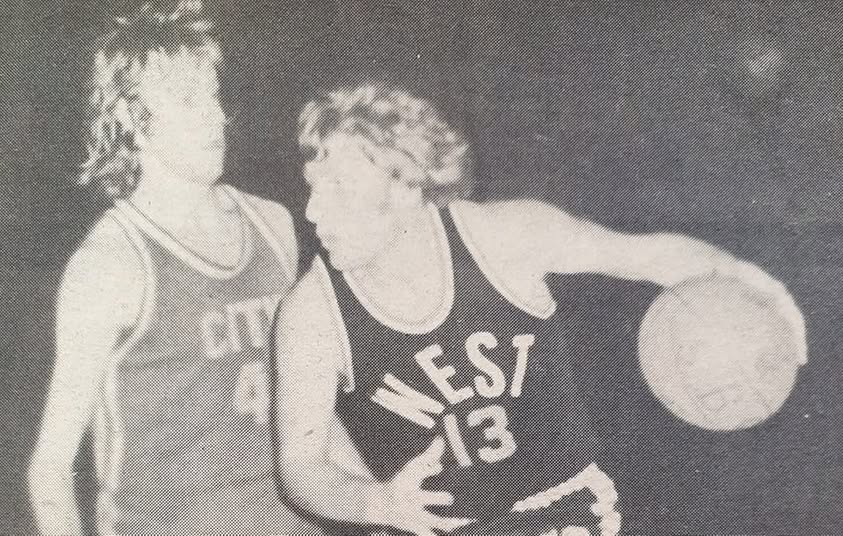 Without doubt though, the star of it was Alan Hughes, West Adelaide's super hustling guard. (If you never had the pleasure of seeing him in action, picture Matthew Dellavedova but with a beautiful shooting action.)
Hughesy hustled, played D and led from the front, also scoring 10 points in the epic 77-70 championship victory but to this day, clear as day, I can see him hitting the last shot of the match - which would've been a 3-pointer today - then running and jumping into my brother Geza's arms as the siren sounded, the crowd roaring its approval. SA was in white (maybe very light blue), Victoria in navy (near enough to black) and the colours were totally appropriate for the night's heroes and villains.
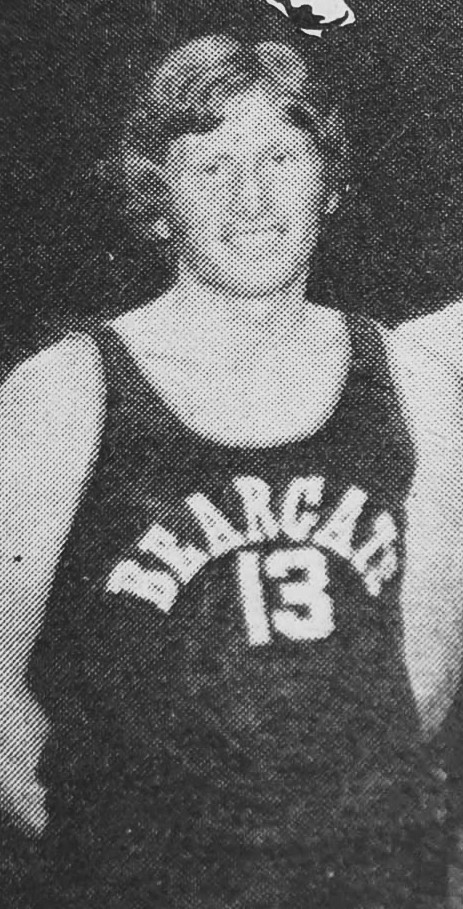 A West Adelaide player and coach through and through - until he left late in his career to be playing-coach of the West Torrens|Forestville Eagles - he is described at the Bearcats' website as "the typical West Adelaide player, defiant, tough and relentless."
Actually, it was Alan who was the blueprint for that. He was extremely popular with Bearcats supporters but his tenacity and neversaydie approach enamoured him far less to opponents and opposition fans. Again, picture Delly (but with a sweet shot!)
My father saw Australia as a land of opportunity for his large family, migrating from war-torn Europe, but as a proud Hungarian, he had some curious habits.
Just as no Australians could look at the surname Nagy and arrive at "Nodge" as the correct pronunciation - every language has its nuances - he often did the same in reverse.
He could not look at Alan's surname withour breaking it into two syllables and Hungarianising it. So in our house, Alan's Hughes surname was known as "Hoog-hash".
Hoog-hash was the bane of Budapest, the nemesis of Norwood - dad's clubs.
A multiple State player through the 1960’s and 70’s, Alan was a player in a wonderful period of the club that captured him six SA Championships. He was an integral piece of the foursome which built West into the state's greatest powerhouse.
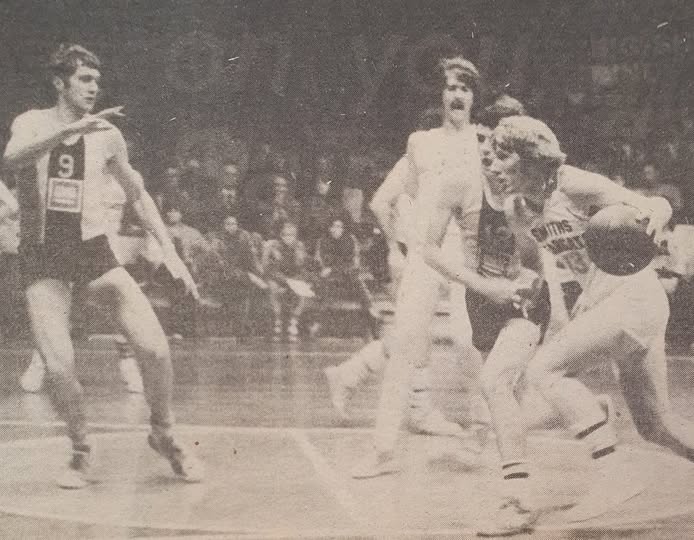 Werner Linde, Roger King in the forward roles, Glenn Marsland and Alan Hughes as the backcourt.
As long as that quartet was intact, West could drop anyone into the centre and they would win the title, be it Bill Stuart, Geza Nagy, Bob Smith, Ken Richardson, it really didn't matter.
That foursome was the Beatles of basketball in SA, Alan also coaching at senior and junior levels for many years at the club, typifying the West Adelaide spirit in his play.
Come national club quests though, and West had its challenges. As state players for SA, they were synonymous with success. But the best they did at an Australian Club Championship was reaching the Final in 1971 and being spanked by Melbourne Church.
It was different for Rick Longley. In those early days of national competition, there was no great expectation for WA's club teams to perform against Australia's best teams.
But Rick was always ready to help in any sort of promotion, as he did here in the picture below I arranged to advertise the 1975 Australian Club Championship. The tournament's four tallest players all agreed to walk across King William St in the city from Rundle Mall for this shot: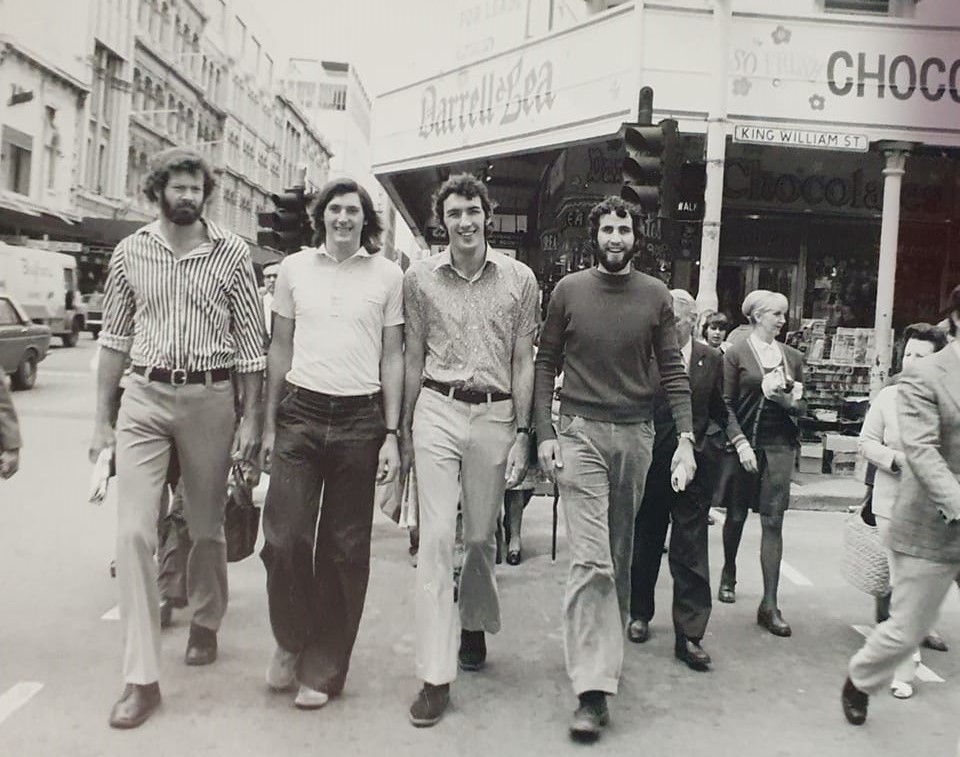
That's Rick, far left, looking like a Viking. He was quite the imposing figure. Unfortunately in Perth's match with St Kilda, Rick accidentally had a finger poked in his left eye.
He went off the court for treatment, came back on but his eye had closed, prematurely ending his tournament. Nurses at Royal Adelaide Hospital extended his bed the full distance to accommodate his length.
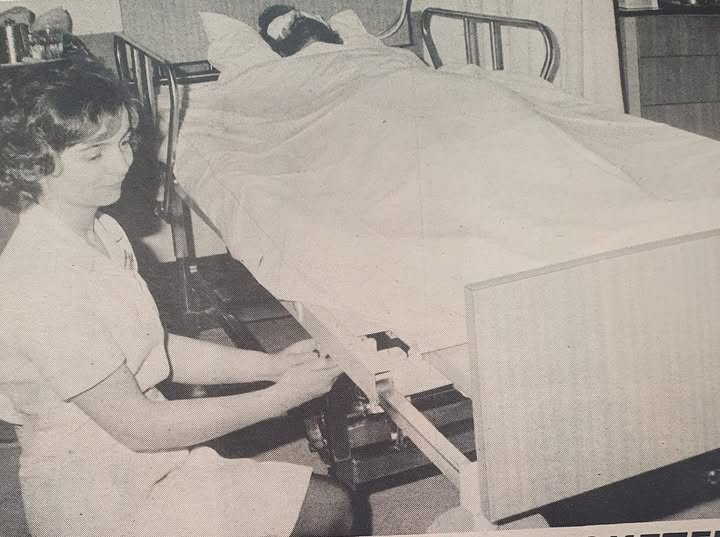
While in hospital, Rick had both eyes bandaged to prevent his right eye from becoming strained and possibly static. "My eye is alright now," he told me at the time.
"It didn't hurt at first but after the game it sure was sore."
Having as a kid watched him intently for WA five years earlier, as his only visitor this was kind of a "pinch me" moment in my young journalistic career.
Rick represented the Boomers in 1971 in New Zealand, played for WA nine times and Victoria four.
In 1982, when Perth played its rookie season in the NBL as the Westate Wildcats, Rick Longley at 40, played eight games for the new club, coming out of retirement and averaging 4.5 points and 3.9 rebounds per outing.
As the NBL's 1982 Media Guide said: "Interest is rising high in the West and the Perth team is expected to become one of the top teams in the NBL within a few years."
Wow, did they ever get that right!
Two of Rick’s sons also went on to play NBL at Perth, Griffin Longley and Luc Longley, the latter a starter on the second threepeat Chicago Bulls NBA championship outfit playing alongside Michael Jordan, Scottie Pippen, Dennis Rodman, Ron Harper, Toni Kukoc and Steve Kerr.
Trailblazers both, may Rick and Alan long be remembered and forever rest in peace. Men such as these were the lifeblood of the sport's emergence.